Post-golf, the boys recovered at the pool and the coaches sought QT after the morning's ramble—or rumble.
I found myself walking on Langtree Avenue after a successful hair trim that could have gone sideways, but didn’t. Shout out to Hewa’s Barber Shop.
Rest days are part of a professional cricketer’s existence, and more often than not, they’re on the road. What to do? Well, golf. We’ve been there. Immersion is my preference. How did Mildura come about, so remote, so different to where we tread normally?
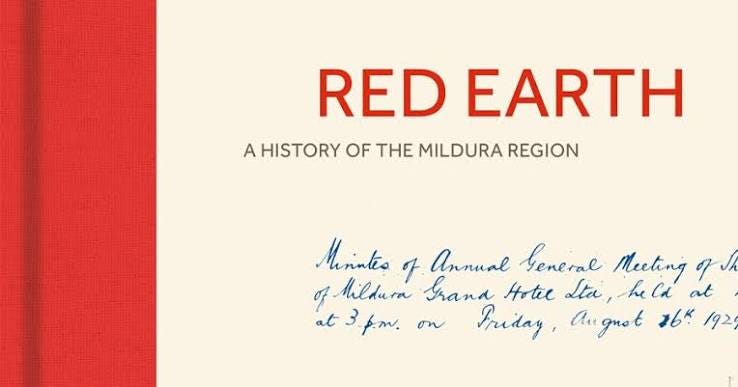
It hasn’t always been the way, but bookshops act like magnets; I find myself drawn to their windows. Hesitant to commit fully, I window-browse first. Red Earth caught my attention—A History of the Mildura Region. Four hundred pages. Hardback. Fifty bucks.
I don’t buy it. Not yet. But I read the back, and that’s enough to keep me thinking for the rest of the day and night.
Mildura comes from the Latje Latje language. It means red earth, or red banks: the cliffs along the Murray, just up from where the Darling comes in. It’s a plain description of what’s there.
After some digging, it seems two Canadian-born brothers, George and William Chaffey, arrived in 1887 via California with an irrigation scheme and laid out a grid town with wide, tree-lined boulevards. They sold the land as “free of any prior claims,” which ignored the people already living on it. The railway they promised didn’t arrive until 1903. Eight years later, the whole thing goes belly-up. Early believers pack up and leave.
The ones who remain are devoid of a better plan—they stay, pooling their fruit, selling it together, just keeping going, and a hundred and thirty-odd years later we’re walking under the trees they planted.
Most things worth keeping get built the same way: first somebody’s big idea, then the smaller, duller work of people who don’t leave.
The dirt is still red. And we’re still 543 clicks from home base.
Nick